

Water Recycling Technology: How Do Closed-Loop Systems Contribute to Operational Efficiency and Environmental Sustainability?
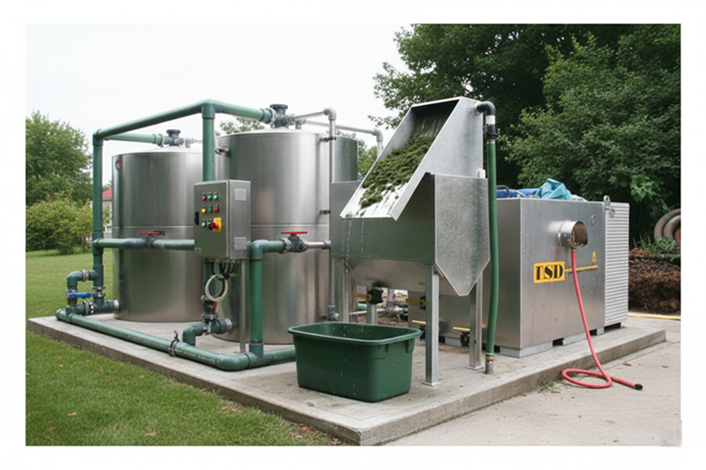
In light of increasing climate challenges and dwindling global water resources, water conservation is no longer merely an ethical choice for industrial and commercial facilities, but has become an urgent economic and legal necessity. The ESD (Environmental System Design) system, pictured, stands out as a revolutionary engineering solution that adopts the concept of a closed loop for 100% water recycling. This article analyzes the engineering, biological, and operational dimensions of this system and how it can transform the cost of water consumption from a financial burden into a sustainable asset.
The System Design Philosophy
The system is based on a philosophy of complex simplicity: simplicity in use and installation, and complexity in internal technology to ensure the highest quality of treated water.
Overground Tanks and Ease of Maintenance
Unlike traditional underground systems, this system features above-ground tanks. This design is not merely aesthetic; it’s an engineering decision aimed at:
- Rapid Maintenance: Direct access to all mechanical and electrical components without the need for excavation equipment.
- Visual Monitoring: Enabling operators to detect any leaks or water quality issues with the naked eye as soon as they occur.
Modular Design
The modular design is a key feature that provides the facility with high flexibility. The system can be installed in confined spaces, and multiple units can be linked together to increase production capacity if the facility expands, making it a scalable investment.
Biotechnology – The System’s Heartbeat
The true secret behind this device’s efficiency lies in its use of natural microbes for water treatment, as shown in the technical specifications image.
Enhanced Microbiological Environment
Microbes are living organisms that are sensitive to temperature and ambient conditions. Therefore, the system is equipped with a warm air blower to maintain an ideal temperature for these microorganisms. This ensures that the microbes remain in their best working condition, accelerating the breakdown of organic matter and pollutants even in the harshest winters.
Biological Media
By providing a massive 2,304 square feet of biological media, this surface area is where beneficial bacteria thrive. The larger this area, the greater the system’s ability to process larger quantities of pollutants in less time, explaining the device’s impressive 3,000-gallon-per-day capacity despite its compact dimensions.
Operating Capacity Analysis
Daily Throughput
With a capacity of up to 3,000 gallons per day, this system is ideal for large car washes, small food processing plants, or heavy-duty maintenance centers. Recycling this large volume translates to annual savings of millions of gallons of fresh water.
Power and Pumping
The system operates on high voltage (380V 3-phase), indicating its design for heavy-duty industrial use. A 1 hp pressure pump ensures efficient distribution of treated water, while a 1.5 hp regenerative blower provides adequate aeration for the water and biological media.
Applications Across Various Sectors and Operational Requirements
The efficiency of the ESD system extends beyond a single sector, encompassing a wide range of industrial applications. In modern car washes. Large volumes of water are required to remove mud and grease. This system acts as a vital source of continuously purified water. In hydroponic farms and agricultural production centers, the requirement for only a 3/4-inch freshwater line makes integration into existing infrastructure easy. Similarly, in heavy-duty maintenance workshops, the 1 hp pressure pump ensures a strong and stable flow that meets the demands of industrial machinery, demonstrating that the system is designed to withstand heavy-duty operation and continuous, high-volume demands.
Read also: Water Recycling Plants in Car Service Centers
Optimal Space Utilization and Operational Efficiency
The system features a compact design that allows for highly efficient use of available space. Although the device does not require a large building footprint. It boasts a high capacity and an operational capacity of up to 860 gallons per cycle. This balance between small size and powerful performance makes it an ideal solution for facilities seeking to maximize their spatial resources. Without compromising the quality or quantity of treated water.
Independent Dirt Settlement Tank
This system utilizes a separate, above-ground settling tank. This component is not secondary; it is the first line of defense.
- Function: It separates sand, dirt, and large particles before the water enters the microbiological stages.
- Importance: It maintains system cleanliness and prevents clogging of the biological media. Thus extending the system’s lifespan and ensuring that the water remains clean during continuous recycling.
Economic Feasibility and Return on Investment
Why Should Companies Switch to a Closed-Loop System?
- Eliminating wastewater charges: In most countries, companies are billed not only for the amount of water they consume but also for the amount they discharge into the sewer system. This system completely eliminates disposal costs.
- Reducing water bills: By consistently reusing the same water, the need for new water is limited to compensating for the minimal losses due to evaporation.
- Protection from penalties: Strict environmental laws impose hefty fines for discharging wastewater contaminated with oils or chemicals. An ESD system ensures that the facility remains outside the realm of legal risk.
Security and Protection
The designers haven’t overlooked physical security. The system is equipped with a lockable security cover and frost protection. This means the system can be installed in open outdoor areas without fear of tampering or damage to the sensitive internal components from extreme cold that could halt biological activity.
Technical Comparison: Why is the Closed Recirculation System Superior?
When comparing traditional open systems to this innovative system, we find significant differences in sustainability. Traditional systems suffer from continuous waste and are directly affected by temperature fluctuations. While the ESD system excels with its 1.5 hp regenerative blower. That replenishes the oxygen necessary for microbes, preventing water spoilage or unpleasant odors. Furthermore, the inclusion of all components as standard means there are no hidden costs or the need to purchase additional parts to get started, making the facility’s financial planning more accurate and transparent from day one of investment.
Summary and Results
The 100% ESD water recycling system represents a significant leap forward in environmental engineering. It combines industrial robustness with bio-intelligence, providing a turnkey solution that includes all essential components as standard.
Investing in this system is not merely a financial expenditure. It’s an investment in the future of your business against fluctuating water prices and stringent environmental regulations. It’s a genuine commitment to the principle of a circular economy. Where no resource is wasted, but rather utilized to its fullest potential.