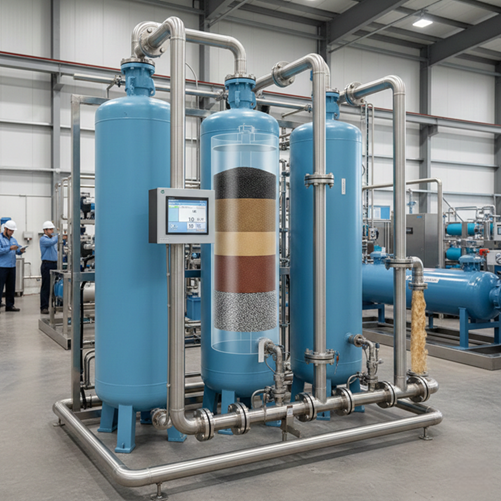


Stages of Ultrafiltration Technology in Water Treatment
Water scarcity and deteriorating water quality are among the most pressing global challenges of the 21st century, necessitating the adoption of innovative and effective water resource management solutions. In this context, ultrafiltration (UF) technology has emerged as a cornerstone of water treatment systems, particularly in the field of greywater treatment and reuse.
Ultrafiltration technology is characterized by its superior ability to remove microscopic pollutants, suspended solids, bacteria, and viruses, ensuring the production of high-quality treated water that meets environmental and health safety standards. This excellence makes it an ideal choice for enhancing resource efficiency and achieving sustainability across various sectors, from individual residential applications to large-scale municipal and industrial facilities.
The ultrafiltration treatment process can be divided into three main stages:
- Pre-treatment: In this initial stage, various processes such as coarse filtration, sedimentation, and agglomeration are applied to remove larger impurities before the water is fed into the ultrafiltration system. This step is crucial for maximizing the overall efficiency of the subsequent filtration process.
- Primary Filtration: During this stage, water is forced through ultrafiltration membranes under pressure, effectively separating permeable purified water from concentrated contaminants. Two common operating modes are used: cross-flow filtration, which continuously circulates a portion of the feedwater to reduce contamination, and closed-end filtration, where the water passes entirely through the membrane, suitable for smaller-scale applications.
- Post-Treatment: Following ultrafiltration, additional treatment steps may include disinfection processes such as UV or ozone treatment to eliminate any remaining pathogens, ensuring the treated water meets safety standards for reuse.
Integrating Membrane Technologies
The use of ultrafiltration (UF) membranes represents a pivotal shift in wastewater treatment methodologies. Ultrafiltration facilitates the removal of fine particles, improving the overall quality of treated greywater. Furthermore, this approach enhances operational efficiency by reducing contamination and extending the lifespan of filtration systems. Research indicates that combining ultrafiltration with other advanced treatment methods, such as nanofiltration and reverse osmosis, can enhance the effectiveness of greywater treatment, particularly in industries with high pollutant loads, such as textiles.
Applications and Versatility
Ultrafiltration systems are not only beneficial for greywater treatment but also have broad applications across various industries, including food processing and textiles, where they help meet discharge regulations and encourage water reuse.
Their adaptability allows for their application in both small-scale (such as individual water purifiers) and large-scale municipal wastewater treatment plants, contributing to sustainable water management practices.
Read also: Advantages of Ultrafiltration Systems for Car Washing
Case Studies
Case studies from diverse geographical contexts
These studies evaluate both developed and developing countries. These studies identify obstacles, such as costs, energy demand, and infrastructure, that may affect the success of these technologies in practical applications.
Ultrafiltration in Greywater Treatment for Residential Applications
One notable case study examines the use of ultrafiltration technology in a detached house in Kelmees, Belgium, where greywater recycling was successfully implemented. The system employed a combination of physical and chemical treatments, including coagulation and ultrafiltration, to ensure the effective removal of contaminants.
This case highlights the potential of ultrafiltration systems to produce high-quality wastewater suitable for non-potable reuse, thus contributing to water conservation efforts in residential areas.
Municipal Applications
In municipal applications, ultrafiltration systems have been integrated into wastewater treatment facilities to enhance water safety and resource efficiency. By improving upon traditional treatment methods, these systems significantly improve the quality of treated water, making it suitable for urban greening, irrigation, and industrial cooling.
For example, the application of ultrafiltration technology in various cities has demonstrated a significant reduction in pathogens and other harmful substances that traditional methods often fail to eliminate, thus contributing to public health protection and improved water quality standards.
Commercial and Industrial Applications
Commercial establishments, such as hotels and shopping malls, have adopted ultrafiltration systems for greywater treatment. These systems not only provide clean water for drinking, and pool maintenance. But also ensure the retention of essential minerals, improving water quality for end users.
The flexibility of ultrafiltration systems allows for customized solutions to meet the specific needs of commercial establishments. Contributing to sustainable water management practices.
Challenges and Barriers
Despite the proven effectiveness of ultrafiltration systems, several barriers hinder their widespread adoption. These include economic viability, regulatory compliance, and societal acceptance. Which can influence decision-makers’ willingness to adopt water reuse technologies. Addressing these challenges is crucial to promoting the use of ultrafiltration in greywater treatment and maximizing its environmental benefits.
Technological Challenges
Integrating ultrafiltration (UF) systems into greywater treatment plants presents several technological challenges. A major challenge is the accumulation of sludge on the membrane surface and within its pores. This occurs when biological materials, solids, or scale build up on the membrane surface and within its pores.
This buildup can lead to reduced membrane flow and increased pressure, ultimately decreasing treatment efficiency. Effective management strategies, including pretreatment processes such as coagulation, agglomeration, and sedimentation, are essential to minimize sludge and extend membrane life. However, these pretreatment steps require additional resources and may complicate the overall system design.
Economic Feasibility
The economic viability of ultrafiltration systems in greywater treatment is also a significant concern. Water reuse offers long-term cost advantages compared to alternative water sources. The initial investment required for ultrafiltration systems can be a barrier to implementation.
Traditional design, tender, and construction (D&C) methods can lead to budget constraints. Limiting the quality and capacity of the treatment system and hindering optimal performance. Furthermore, the costs associated with ongoing maintenance and membrane replacement can accumulate, complicating financial evaluations for potential investors and operators.
Environmental Considerations
Environmental impacts present additional challenges to the widespread adoption of ultrafiltration systems. High energy consumption is a significant concern. As ultrafiltration systems often require substantial energy to maintain operational efficiency. Particularly in large-scale applications. Moreover, the treatment process can generate large quantities of residual sludge, necessitating effective disposal or resource recovery strategies to minimize environmental impact.
Addressing these energy requirements and waste management issues is crucial to ensuring the sustainability of greywater treatment solutions.
Regulatory and Social Acceptance
The regulatory framework surrounding wastewater treatment technologies can also be a barrier. Stringent compliance requirements can complicate the deployment of new ultrafiltration systems, especially in areas with strict regulations on wastewater discharge. Overcoming these social and regulatory barriers requires transparent communication, public awareness campaigns, and community engagement to promote the acceptance of advanced treatment technologies.
Addressing these challenges through public education and streamlined regulations will be crucial for the wider adoption of greywater recycling technologies.