

Reverse Osmosis Applications in Desert Environments: The Royal Commission for AlUla’s Model
AlUla is one of the world’s most important tourist and historical destinations. But behind its captivating beauty lie highly complex natural and hydrological challenges. In an arid desert environment, the “smart use of limited resources” is not just an option, but an existential necessity.
The Royal Commission for AlUla has adopted an ambitious vision to transform environmental challenges into opportunities for technological innovation. This is embodied in the “innovative system” showcased in our project today. That represents a cornerstone for a sustainable future and a healthy environment.
Water management in a region like AlUla requires solutions that go beyond traditional methods. It necessitates the precise integration of advanced mechanical engineering, biochemistry, and artificial intelligence in process management. Here, reverse osmosis technology emerges as the most effective solution for addressing water challenges in areas that rely on groundwater or non-conventional sources.
Read more about promoting sustainability at the Royal Commission for AlUla
First: Engineering and Technical Specifications of the System
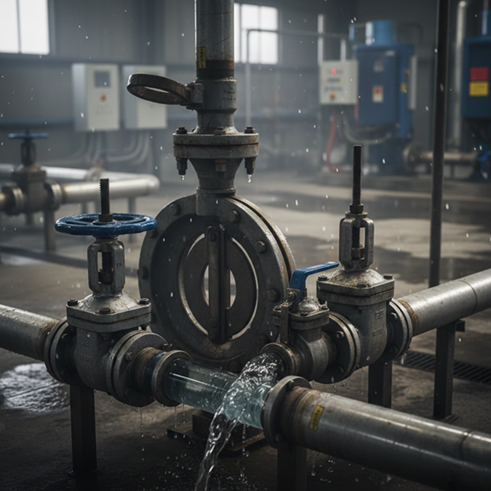
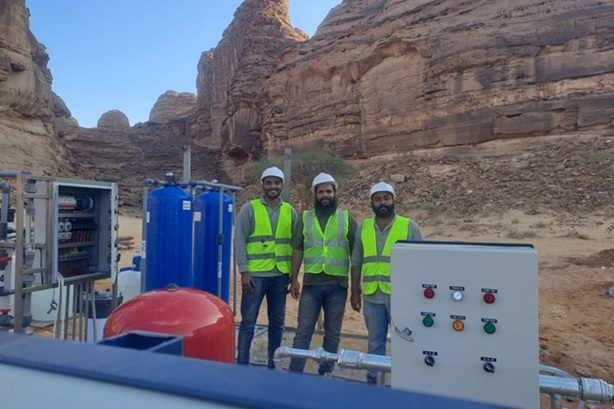
Analyzing the project’s technical specifications, we find a “technological poster” showcasing the latest advancements in water treatment technology. The system comprises several software and engineering units that work in perfect harmony:
High-Pressure Units and Membrane Vessels
The high-pressure units and membrane vessels are among the most important components of the reverse osmosis (RO) water treatment plant. These vessels are designed to withstand extremely high operating pressures, as raw water is forced through them via semi-permeable membranes. These membranes operate at the molecular level, allowing only water molecules to pass through while blocking dissolved salts, bacteria, and viruses, thus ensuring the production of exceptionally pure water that meets international standards.
The Intelligent Control and Monitoring System (The Control Hub)
The brain of the plant and the interface to an automated control system that continuously monitors the following variables. This panel is not simply a set of switches; it includes:
- Flow Rate: To ensure the stability of the water supply. Total Discharge (TDS): Real-time monitoring of the water output quality.
- Operating Pressure: Protection of the membranes from damage caused by pressure fluctuations.
This level of automation reduces human intervention and ensures continuous, highly efficient operation under AlUla’s high temperatures.
Resource Pumping and Distribution System
The project includes advanced booster pumps designed to operate in harsh environments. The use of a pressure tank (water accumulator) aims to absorb hydraulic shocks and prevent water hammer, thus extending the lifespan of pipes and equipment. This is an integral part of the Authority’s sustainability vision.
Second: Geological and Environmental Challenges in AlUla
Implementing RO technology in AlUla is not as straightforward as in other coastal areas. Several factors make this project an engineering success story:
- Raw Water Characteristics: Groundwater in mountainous and desert regions is often rich in heavy minerals and hard salts. The innovative system here is designed with a robust pre-treatment to address these components before they reach the sensitive membranes.
- Aesthetic and Archaeological Considerations: The Royal Commission is committed to ensuring that technological projects are “compact” so as not to detract from the visual landscape of historic AlUla. The visible station features a design that maximizes space and performs complex functions within a limited area.
Third: Sustainability in Action
The Royal Commission affirms that this project “embodies our vision for a sustainable future.” But how is this achieved technically?
- Circular Water Economy: By treating water and reusing it for irrigation or construction purposes, reliance on depleting non-renewable groundwater aquifers is reduced.
- Energy Efficiency: Modern systems utilize energy recovery technologies, minimizing the station’s carbon footprint and making it environmentally friendly.
- Achieving a Healthy Environment: Providing high-quality treated water directly contributes to improving the quality of life for residents and visitors. It is referred to as “a better life and a healthier environment” in the project’s objectives.
Fourth: Human Resources – The Engine of Innovation
The true success story lies in:
- Localization of Knowledge: The ability of young Saudis to manage and maintain the most complex water treatment systems in challenging field conditions.
- Precise Engineering Supervision: Ensuring that every valve and every electrical wire operates according to the highest international safety and quality standards.
- Team Spirit: The integration between field engineers and technical designers to deliver customized solutions that meet AlUla’s unique needs.
Fifth: Future Vision and Strategic Impact
The success of the reverse osmosis model at the Royal Commission for AlUla paves the way for larger and more ambitious projects. We are talking about a system that not only solves an immediate problem but also lays the foundation for:
- Sustainable Water Security: Ensuring reliable water sources that support the region’s growing tourism.
- Smart Irrigation: Utilizing the output of these plants to transform desert areas into green oases using smart irrigation technologies linked to the treatment system.
- Technological Excellence: For AlUla to become a global role model in how to integrate advanced technology with natural heritage without compromising either.
Certainly, adding a detailed section on the technical and economic advantages of reverse osmosis (RO) technology would give the article greater scientific depth. It would also underscore why the Royal Commission specifically chose this technology as a strategic solution.
Sixth: The Strategic and Technical Advantages of Adopting Reverse Osmosis (RO) Technology
Reverse osmosis (RO) technology is considered the gold standard in water treatment globally, especially in regions with harsh climates such as the Arabian Peninsula. The importance of this technology lies in its ability to…
Its superior performance lies in achieving a delicate balance between output quality and operating costs, and among its most prominent scientific advantages are:
Unmatched Purity in Contaminant Removal
RO technology surpasses conventional filtration systems by its ability to trap particles as small as 0.0001 microns. This precision allows for the removal not only of up to 99% of dissolved salts, but also of organic pollutants, heavy metals, and microscopic viruses. In the context of the AlUla project, this level of purity ensures water that meets the most stringent environmental standards. Thus protecting the region’s fragile ecosystem.
Operational Flexibility and Versatility
Reverse osmosis units are highly flexible in handling diverse water sources, whether it be highly saline groundwater, treated wastewater, or even surface water. This “technical flexibility” allows the Royal Commission to adapt the system to operate according to the available resources in each geographical location within the governorate, reducing the need to construct massive and complex infrastructure for transporting water over long distances.
Economic Feasibility and Carbon Footprint Reduction
Unlike older thermal desalination technologies that consume enormous amounts of energy to evaporate water, RO technology relies on mechanical pressure, making it more than 70% less energy-efficient in many cases. Furthermore, modern integrated systems allow for the use of energy recovery devices, which convert some of the lost pressure back into operational energy. This reduces the overall operating cost (OPEX) in the long run and contributes to achieving carbon sustainability goals.
Scalability and Compact Design
RO plants are modular systems. This means that the plant’s production capacity can be increased simply by adding more membrane vessels without needing to redesign the entire system. Their compact design also makes them ideal for the mountainous terrain of AlUla. The plant can be installed in limited spaces without impacting the area’s topography or its aesthetic and archaeological significance.
Environmental Sustainability and the Protection of Natural Resources
By providing a reliable and alternative water source, this technology helps alleviate the direct pressure on deep aquifers. That took thousands of years to form. The Royal Commission’s adoption of this technological solution reflects an ethical and scientific commitment to preserving the “trust of resources” for future generations, while ensuring the continued development of the region.