

How to Transform from a Burden of Operating Treatment Plants to a Strategic Investment in Saudi Arabia
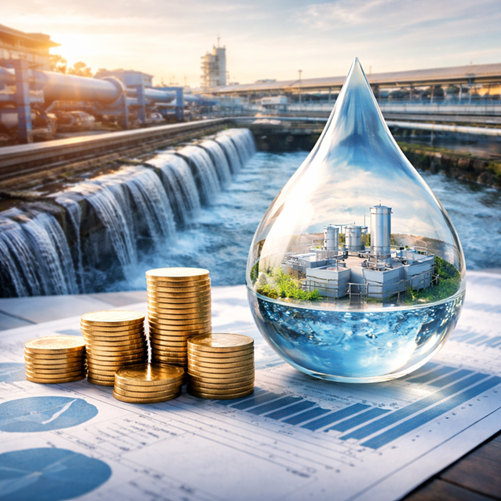
Water treatment projects in Saudi Arabia are no longer merely considered environmental solutions or regulatory obligations. They have become a pivotal element in the sustainable economy and an investment vehicle capable of generating tangible returns in the medium and long term. With rapid urban and industrial growth and rising water demand amidst limited natural resources, operating treatment plants—if well-designed and managed—has become a strategic asset, managed with an investment mindset no less important than any other infrastructure project.
This shift in perspective on water projects raises a fundamental question: How can a water treatment plant be transformed from a continuous cost center into an economic asset that generates real value?
First: The Water Sector in Saudi Arabia: Between Scarcity and Economic Opportunities
The Kingdom is among the countries with the most scarce natural water resources, making water management a strategic issue directly linked to national security and economic development. In this context, Saudi Vision 2030 has adopted a clear approach based on efficient resource utilization and maximizing the benefits of non-conventional water sources, particularly treated wastewater.
This approach has led to rapid growth in wastewater treatment plant projects across the residential, industrial, tourism, and agricultural sectors. However, the real challenge lies not only in constructing these plants but also in managing them in a way that ensures financial sustainability and achieves the best possible balance between cost and return.
Read also: How to Ensure the Efficient Design of Water Treatment Plants from Planning to Maintenance?
Second: From Compliance to Investment
Traditionally, wastewater treatment plants were viewed as a mandatory requirement imposed by environmental regulations and were often managed with a “minimize losses” mentality. This approach often leads to:
- Choosing less efficient technologies in the long run.
- High operating and maintenance costs.
- Low utilization of treated wastewater.
- The absence of clear economic performance indicators.
In contrast, treating the wastewater treatment plant as an investment asset completely changes the decision-making equation, shifting the focus to:
- The efficiency of the entire project lifecycle.
- Direct and indirect financial returns.
- Added value of treated water.
- Operational flexibility and scalability.
Third: Understanding the true costs of treatment plants
To analyze the economic feasibility of any water treatment project, a clear distinction must be made between two types of costs:
Capital costs (CAPEX):
These include the cost of design, construction, equipment, control systems, and associated infrastructure. Some investors often err by focusing solely on reducing these costs without considering the impact on long-term performance.
Operating costs (OPEX):
These include energy consumption, chemicals, routine maintenance, spare parts, and labor. This highlights the importance of selecting the appropriate technology, as a technology with a higher initial construction cost can achieve significant operational savings over the years of operation.
The crucial point is that a correct economic evaluation should be based on the Total Cost of Ownership (TCO), not just the initial construction cost.
Fourth: Technologies and their impact on economic returns
The economic feasibility of treatment plants varies depending on the technology used. For example:
- Advanced biological systems can provide high-quality water with lower energy consumption.
- Reverse osmosis systems produce highly purified water but require careful management of energy and brine.
- Greywater treatment systems are among the most profitable solutions for residential and commercial projects due to their short recovery cycle.
- The smart choice of technology depends not only on the required water quality but also on the nature of the end use, the volume of demand, and the possibility of internal or external reuse.
Fifth: Profitable Models for Water Treatment Projects
Treatment projects can be transformed into income-generating assets through several operational models, most notably:
Internal Reuse of Treated Water
In residential complexes, hotels, and commercial projects, using treated water for irrigation, cooling, or utilities directly reduces water bills, which is reflected in the project’s cash flow.
Selling or Supplying to Others
In some areas, treated water can be supplied for agricultural or industrial purposes within specific regulatory frameworks, creating an additional source of income.
Water as a Service (WAS) Model
In this model, the plant is operated by a specialized entity in exchange for fees linked to the volume of water treated or the quality of its performance. This reduces operational risks for the owner.
Public-Private Partnerships (PPPs)
PPPs are among the most promising models for implementing and operating water treatment projects, particularly large-scale projects and strategic infrastructure. This model is based on distributing roles and responsibilities between government entities and the private sector in a way that balances public interest with operational efficiency. Government entities are responsible for establishing regulatory frameworks and ensuring service continuity, while the private sector provides technical expertise, financial capacity, and efficient management and operation.
This model allows for intelligent risk sharing, as each party is assigned risks that it can manage most effectively. For example, the private sector assumes the risks of design, implementation, and operation, while government entities bear the regulatory risks or those related to long-term demand. This distribution reduces the financial burden on governments and enhances project sustainability through a long-term operational commitment based on clear performance indicators.
In the water treatment sector specifically, partnership models have proven effective in improving service quality. And reduce operating costs on the Long-term partnerships accelerate project implementation compared to traditional models. These partnerships also facilitate the introduction of advanced technologies and the application of global best practices in operation and maintenance, while maintaining government oversight and ensuring compliance with environmental and health standards.
Sixth: Economic Performance Indicators
To ensure the project’s success as an investment asset, clear performance indicators must be adopted, the most important of which are:
- Return on Investment (ROI).
- Payback Period.
- Cost per cubic meter of treated water.
- Ratio of treated water versus fresh water.
- Long-term performance stability and water quality.
- The absence of these indicators transforms the plant into an operational burden, regardless of its technical efficiency.
Read also: Behind Every Successful Project: The Hidden Power of Outstanding Technical and Financial Offers
Seventh: The Role of Smart Operation and Preventive Maintenance
Modern monitoring and control technologies, such as SCADA systems and predictive analytics, play a crucial role in improving economic returns. Data-driven preventive maintenance reduces unexpected breakdowns, extends equipment lifespan, and lowers unforeseen operating costs. Furthermore, relying on a specialized operator with local expertise and knowledge of Saudi regulations directly contributes to stable performance and operational savings.
Eighth: Water Treatment as a Competitive Advantage for Projects
In the Saudi market, real estate and industrial development projects have begun to realize that having an effective water treatment system is no longer just an operational requirement, but has become:
- An attraction for investors.
- An asset value enhancer.
- An indicator of commitment to sustainability.
- A tool for improving the environmental rating of projects.
Thus, the treatment plant transforms from a “back-end service” into a significant competitive advantage in investment decisions.
Conclusion: Smart Investment Starts with Water
Transforming water treatment projects into economic assets requires a fundamental shift in mindset. It requires moving from a focus solely on compliance to adopting a comprehensive investment perspective that balances technology, operations, and financial returns. In an environment like Saudi Arabia, where water scarcity intersects with ambitious development goals. This transformation becomes not an option, but a strategic imperative.
Companies and institutions are beginning to treat treated water as a measurable economic value. It will be best positioned to achieve both financial and environmental sustainability. And it will possess a real competitive advantage in a market that is steadily moving towards efficiency and innovation.