

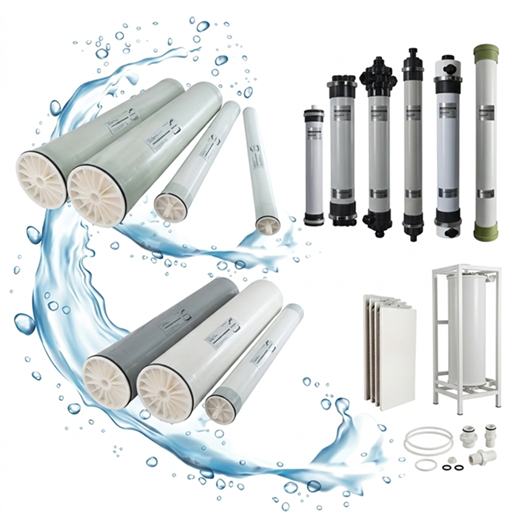
Membrane Performance Measures in Reverse Osmosis Systems
Membrane performance is a critical aspect of reverse osmosis systems, directly impacting contaminant removal efficiency and the quality of treated water. Key performance indicators include filter flow rate, salt rejection rate, and salt passage rate, all of which are influenced by various operational and environmental factors.
- Filter Flow Rate: Filter flow rate is defined as the volume of filter material produced over a specific time period and a given area of the membrane surface. For example, a flow rate of 15 gallons per day per square foot indicates the membrane’s efficiency in producing clean water. A low filter flow rate often indicates membrane contamination. Particles and organic matter accumulate on its surface, increasing flow resistance and requiring higher operating pressures.
- Salt Rejection Rate and Passage Rate: Salt rejection rate is the membrane’s efficiency in removing dissolved salts from the feed water and is typically measured as a percentage.
- Salt Passage Rate: This measures the amount of salt that passes through the membrane and is the inverse of the salt rejection rate. A high salt pass-through rate indicates potential membrane degradation or contamination.
A high-performing reverse osmosis (RO) membrane typically achieves a salt rejection rate of 95% to 99% for contaminants of a given size and charge.
Recovery Rate
The recovery rate refers to the percentage of feedwater converted into filtered water. It is a crucial factor in evaluating the operational efficiency of a reverse osmosis system. High recovery rates can lead to increased sludge buildup on the membrane surface due to the concentration of dissolved minerals in the feed stream. Maintaining an optimal recovery rate is vital to prevent contamination and ensure sustainability.
Factors Affecting Performance Indicators
The performance of RO membranes is influenced by several factors, including feedwater temperature, pressure, total dissolved solids (TDS), and pH level. Increasing the feedwater temperature generally improves filter throughput with a slight decrease in salt rejection. Furthermore, optimizing pretreatment processes is essential to minimize contamination and extend membrane life.
Maintenance Practices
To ensure the longevity and optimal performance of reverse osmosis membranes in industrial applications, a comprehensive maintenance strategy is essential. This strategy includes periodic monitoring, cleaning, and preventative maintenance procedures designed to prevent contamination, deposits, and other common problems associated with membrane systems.
Read also: Factors Affecting Membrane Lifespan
Periodic Monitoring
Continuous monitoring of key performance indicators (KPIs) is vital for assessing membrane condition. Important KPIs include membrane transfer pressure and filter flow rates. Deviations in membrane transfer pressure can indicate blockages or potential contamination, while low flow rates may indicate efficiency issues or system contamination. Regularly tracking data helps identify trends that may necessitate maintenance or upgrades, reducing the risk of unexpected failures.
Periodic maintenance tasks include backwashing filters, chemically cleaning membranes, and replacing consumable components such as rubber O-rings and membranes. By adhering to a regular maintenance schedule, operators can avoid costly repairs and downtime while ensuring compliance with the manufacturer’s warranty requirements.
Record Keeping
Maintaining detailed operational records during each maintenance visit is crucial for tracking performance patterns and scheduling timely replacements. This historical data helps operators understand the membrane lifecycle and can guide future maintenance practices.
Waste Management and Sustainability
Managing waste generated by reverse osmosis systems is critical for promoting sustainability in industrial applications. The serious environmental impacts of improper disposal methods highlight the need for effective waste management strategies. When brine, a byproduct of the reverse osmosis process, is discharged without adequate treatment, it can lead to water pollution, soil degradation, and damage to aquatic and terrestrial ecosystems. With increasing water scarcity and pollution globally, it is essential to adopt innovative and sustainable wastewater management strategies.
Brine Management
Brine produced by reverse osmosis systems is often highly concentrated with salts, heavy metals, and organic compounds, which can severely harm local ecosystems if released into freshwater bodies or coastal environments. Therefore, effective disposal and management strategies are essential to mitigate these risks. Common methods include discharging brine into municipal sewer systems, where it is treated alongside other wastewater, and using evaporation ponds to extract salts. However, these methods must be carefully selected to avoid creating additional environmental burdens.
Advanced Wastewater Treatment Technologies
The emergence of advanced treatment technologies, such as membrane technology. It has shown promising potential in enhancing the sustainability of wastewater treatment processes. These technologies enable efficient water recovery and the production of treated water suitable for diverse applications, including agricultural and industrial uses. Furthermore, adopting circular economy principles in wastewater treatment focuses on resource recovery. Including the extraction of valuable compounds and nutrients from wastewater. This shift towards a waste-to-resource model can significantly improve the sustainability of industrial practices.
Energy Recovery and Resource Efficiency
Integrating waste-to-energy technologies into reverse osmosis systems can enhance environmental sustainability by generating renewable energy from organic waste and reducing reliance on fossil fuels. This integration not only improves energy efficiency. Wastewater treatment plants not only contribute to a low-carbon future but also to a sustainable future. Collaboration between academia, industry, and policymakers is crucial to translating these advanced technologies into practical solutions that effectively address global water challenges.
Types of Membrane Pollution and Chemical Cleaning Strategies
The performance of membranes cannot be discussed without addressing their “hidden enemy”: pollution. Membrane pollution is not limited to one type but takes many forms. There is biological pollution, caused by the growth of bacterial and algal colonies that form a slimy layer, obstructing water flow. There is also scaling, which occurs when salts exceed their solubility limit and precipitate as hard scales of calcium carbonate or sulfates.
Therefore, chemical in situ cleaning (CIP) protocols are essential. This process involves circulating specialized chemical solutions. Dilute acids (such as citric acid) are used to dissolve mineral scales. Strong alkaline detergents are used to remove organic matter and oils. Choosing the right detergent and the ideal cleaning time—before the flow rate drops by more than 15%—is what makes the difference between a membrane that lasts for years and one that fails in months.
Pre-treatment as a Strategic Line of Defense
The longevity of a reverse osmosis system is fundamentally linked to the efficiency of the pre-treatment unit. Instead of placing the entire burden on the delicate membranes. Sand and activated carbon filtration systems remove suspended solids and chlorine. That can cause membrane surface oxidation.
Furthermore, the integration of ultrafiltration technologies as a preliminary step has revolutionized performance stability. It ensures a feed water with a very low turbidity index (SDI). The precise application of chemically calculated antiscalants prevents salt crystallization on the membrane surface. This extends the system’s lifespan and reduces forced downtime for maintenance. Thus, achieving a balance between production efficiency and operating costs.
Digital Transformation and Predictive Maintenance (Vision 2026)
As we enter 2026, managing reverse osmosis plants will no longer rely solely on traditional manual monitoring. Instead, it will transition to the era of digital twins and artificial intelligence. Integrated smart sensors enable real-time monitoring of membrane transport pressure, temperature, and salinity.
Advanced algorithms can now predict contamination well in advance by analyzing historical data patterns. This allows operators to perform predictive maintenance. This digital transformation not only enhances resource sustainability but also reduces energy and chemical consumption. It ensures the system remains within its optimal performance limits with minimal human intervention, significantly reducing operating expenses (OPEX).