

Containerized Water Treatment Plants as a Smart Infrastructure Strategy
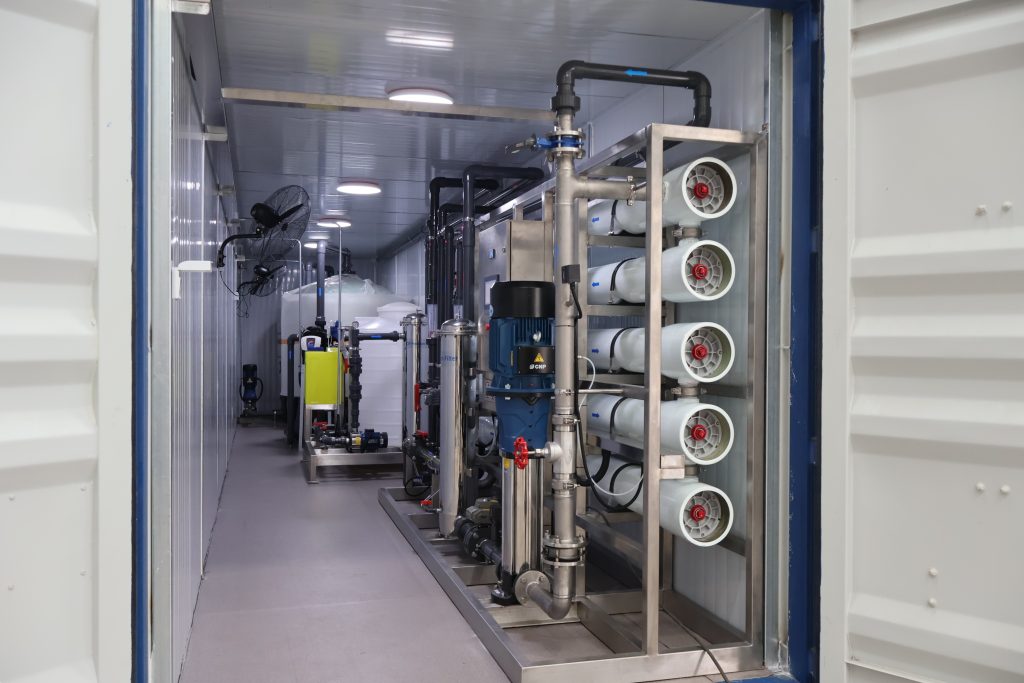
In a world facing increasing challenges in securing clean water resources and managing wastewater efficiently, containerized water treatment plants have emerged as a revolutionary solution, redefining the concept of water infrastructure. This technology transcends the concept of mere “mobile equipment,” becoming a fully integrated water plant assembled and tested within a standard steel shipping container (ISO Standard Container), ready for immediate use anywhere on the planet.
This article explores the strategic dimension of these plants, moving beyond their traditional applications in relief and remote areas to delve into their integration into smart urban development plans, industrial self-sufficiency, and advanced water treatment.
Read more about what reverse osmosis containers are.
Beyond Reverse Osmosis: The Diversity of Containerized Treatment Plants
These containers have long been technically associated with reverse osmosis (RO) systems for water desalination. But modern engineering has transformed the container into a versatile platform capable of accommodating various complex water treatment technologies. This flexibility has opened new doors for applications, particularly in wastewater treatment and reuse.
Integrated Technology Options:
- Sewage Treatment Systems: Integrated membrane bioreactors (MBRs) are incorporated within the container. The MBR system provides very high-quality treated wastewater that can be reused for irrigation or even cooling industrial processes, all within a minimal footprint.
- Ultrafiltration and Nanofiltration (UF/NF): These units are used to treat surface water (rivers and lakes) where the process requires the effective removal of turbidity, suspended solids, and parasites, without the complexities of desalination.
- Specialized Industrial Water Treatment Units: The container can be customized to treat feedwater for boilers and cooling towers in factories. These processes require water free of salts and minerals to prevent scaling and corrosion, necessitating fully integrated softening or deionization systems.
- Advanced Disinfection Systems: Ozone or UV sterilization units are integrated for pre- or post-treatment of water, ensuring the highest levels of biosafety in the produced water.
This versatility means that containerized water is no longer just a solution for producing drinking water, but has become a crucial tool in achieving closed-loop systems that aim to reduce water waste in industry.
Smart Cities and Logistics Footprint: When is a Container the Smarter Option?
The true value of containerized units lies in their ability to overcome space and time constraints in advanced urban and industrial environments. In these sectors, logistical and land costs are critical factors that render traditional solutions unfeasible.
Self-Sufficiency for High-Value Business Facilities:
- Data Centers: These centers consume enormous quantities of purified water for cooling (especially evaporative cooling). An integrated water treatment unit can provide consistent. Customized water quality can be rapidly and directly deployed near the center. This reduces reliance on municipal water supplies, which can be volatile in quality and pressure.
- Luxury hotels and resorts (in densely populated cities): These establishments cannot afford water supply interruptions or declining water quality. Furthermore, they face pressure to manage their water footprint. A container can be deployed to treat greywater generated from rooms (shower and laundry water). Then reused for garden irrigation, air conditioning cooling, or restrooms. This can save up to 40% of the building’s total water consumption.
- Cloud kitchens and centralized restaurants: Food processing operations require ultra-pure water. A containerized system ensures consistent water quality and is easily relocated if operations expand or the kitchen relocates, thus preserving asset value.
Water management solutions in logistics zones and seasonal gatherings:
- Free zones and ports: These areas are highly valuable real estate assets. Constructing a traditional treatment plant requires years and vast spaces. A containerized system offers a rapid solution for treating industrial wastewater from shipping operations or providing high-quality water for transiting vessels. With the capability to be relocated upon project completion or expansion.
- Temporary and seasonal residential complexes, such as Hajj and Umrah camps. Large sporting events (like temporary stadiums for the World Cup) or tourist resorts that operate for only six months of the year. Here, the need is for highly efficient sewage treatment without leaving behind permanent and costly infrastructure. Containerized MBR/sewage treatment units are rapidly deployed and removed after the season ends, significantly reducing the environmental footprint and long-term capital costs.
Future Integration: Sustainability and Automation at the Heart of the Container
Container terminals have become smart engineering hubs that rely heavily on digitalization and automation to ensure maximum efficiency and minimize operating costs.
Advanced Automation and Operational Intelligence:
- Internet of Things (IoT) and Remote Monitoring: Each unit is equipped with advanced sensors that measure. In real time, the quality of the produced water, pump pressure, membrane efficiency, and energy consumption are monitored. This data is transmitted over the internet to a central cloud. An operations team anywhere in the world can monitor performance and diagnose faults, creating what is known as the unit’s Digital Twin.
- Autonomous Operation and Adaptive Programming: Intelligent systems allow the unit to dynamically adjust operating parameters. If the raw water temperature rises, the unit automatically adjusts pump pressure or changes backwash schedules to ensure stable water quality, minimizing the need for operator intervention.
Sustainability and Energy Integration:
- Hybrid Power Plants: The ease of integrating renewable energy sources is a major competitive advantage. Solar panels can be installed directly on or alongside the container roof to cover a significant portion of its operational needs, particularly in areas with high solar irradiance. This creates a fully self-sufficient and sustainable solution.
- Energy Recovery Devices (ERDs): In reverse osmosis (RO) systems, integrated ERDs can be installed. These devices utilize residual pressure in the wastewater to push the raw water, significantly reducing overall electricity consumption. This technology was once limited to large plants but is now essential in containerized units.
Smart Deployment Challenges and Future Prospects
Despite its enormous advantages, this approach presents challenges that must be overcome to ensure sustainable operation:
- Adapting to the Operating Environment: Steel containers are highly susceptible to harsh climatic conditions. Operation in the desert requires robust, specialized air conditioning systems and highly. Efficient thermal insulation to protect sensitive equipment (such as membranes) from deterioration due to excessive heat or freezing.
- Brine Management: In RO systems, highly saline water is discharged. In remote areas or on islands, the container design must incorporate smart solutions for treating this wastewater (such as evaporation ponds) rather than simply disposing of it, to minimize the environmental impact.
- Maintenance and Specialization: Despite automation, these units require highly specialized operator training. Their compact and integrated design makes accessing certain components for complex maintenance a matter of expertise.
Conclusion: Redefining Water Infrastructure
Containerized bottled water treatment plants are no longer just a “temporary solution”. They represent a new business model for water infrastructure based on the Water as a Service (WAS) model.
They offer the ideal combination of:
- Ultimate Deployment Speed: From months to days.
- Capital Efficiency: Reduced fixed construction costs.
- Portability: An investment that can be moved and reused in multiple projects.
For smart cities, ambitious industrial sectors, and effective climate change mitigation efforts. These robust steel containers offer a practical logistical and technological solution. They demonstrate that access to clean water or efficient wastewater treatment is no longer dependent on massive and slow infrastructure. But it is a right that can be realized by bringing a complete, innovative water treatment plant to you, wherever you are.