

Challenges and Innovations in WellWater Treatment for Large-Scale Agricultural Projects
Groundwater extracted from wells is the backbone of horizontal agricultural expansion in arid and semi-arid regions. However, the raw nature of this water often carries chemical and biological risks that threaten soil sustainability and crop health. Well water treatment for large-scale projects is not merely a technical process, but an integrated system where legal regulations, financial pressures, and digital innovations intersect.
Read also: Benefits of Well Water Treatment for Large-Scale Agricultural Projects
Part 1: Regulatory Challenges and Legal Compliance
Agricultural investors in large-scale projects face a complex web of laws aimed at protecting natural resources. Regulatory compliance is not just a paperwork procedure; it is a long-term commitment that impacts the project’s sustainability.
Water Quality Standards and Clean Water Acts
Governments set strict standards for what can be added to the soil or discharged into waterways. Well water must undergo regular laboratory analysis to detect levels of nitrates, phosphates, and heavy metals such as lead and arsenic. The Clean Water Act (CWA) and similar local legislation mandate strict protocols to prevent pollution from the runoff of chemically treated water.
Analysis of Alternatives and Environmental Impact Assessment
Before embarking on any large-scale treatment project, farmers are required to submit an Environmental Impact Assessment (EIA). This assessment includes:
- Aquifer Depletion: Evaluating whether water extraction will lead to land subsidence or salinization of nearby wells.
- Brine Management: In desalination systems, the disposal of concentrated brine presents a significant environmental challenge, requiring special permits to ensure no harm is done to the surrounding environment.
Part 2: Financial Considerations and Economic Feasibility
Water treatment budgets are among the largest expenditure items on large farms. These costs are distributed across several areas:
Capital Costs (CAPEX)
These include the cost of drilling deep wells, constructing reverse osmosis plants, purchasing sand and carbon filters, and installing corrosion-resistant piping systems. In large projects, these costs can reach millions of dollars.
Operating Costs (OPEX)
The major challenge lies in continuous operation. These costs include:
- Energy Consumption: Desalination plants consume enormous amounts of electricity.
- Chemicals: pH adjusters, antiscalants, and disinfectants.
- Routine Maintenance: Replacing membranes affected by organic impurities and salts.
Financial Risk Analysis
Failure to invest in proper treatment can lead to significant losses, such as soil salinization rendering it unsuitable for agriculture for years, or crop rejection in export markets due to contaminants. This makes treatment costs an essential “preventive investment.”
The Challenge of Suspended Matter and System Clogging
- The challenge: Well water often contains fine sand, silt, and suspended organic particles. In large-scale drip irrigation projects, these impurities quickly clog emitters, causing uneven water distribution, crop loss, and substantial irrigation network replacement costs.
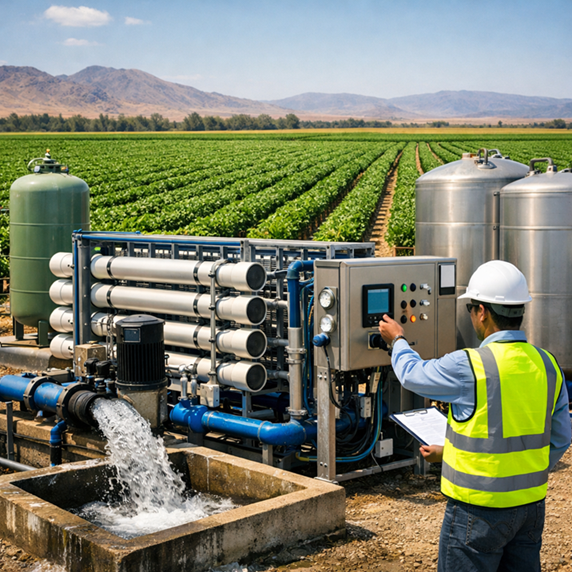
- Innovative Solution (Automatic Sand Filters): Instead of traditional filters that require system shutdowns for manual cleaning, modern systems utilize “self-backwashing” technology. These filters sense the pressure difference caused by dirt buildup and automatically clean themselves without interrupting the water flow to the field, ensuring 100% continuous operation.
Biological Threats and Chemical Limitations
- Challenge: Well water can become contaminated with harmful bacteria or algae, especially in shallow wells. The traditional solution was chlorination (adding chlorine), but high concentrations of chlorine alter soil chemistry, kill beneficial bacteria, and can be toxic to some sensitive plants, in addition to the risks associated with handling and storage.
- Innovative Solution (Ultrafiltration and UV): Ultrafiltration acts as a physical barrier with nanopores that prevent the passage of viruses and bacteria without the use of chemicals.
Ultraviolet (UV) sterilization uses a specific wavelength to instantly destroy the DNA of microbes. The result is “biologically safe” water that leaves no chemical residue in the soil or on export-oriented crops.
The Salinity Crisis and High Energy Bills
- The Challenge: Total Dissolved Solids (TDS) is the number one enemy of agriculture. Reverse osmosis (RO) is an effective solution, but historically it has consumed enormous amounts of electricity, making the cost per cubic meter of treated water uneconomical for medium-value crops.
- The Innovative Solution (Nanomembranes and Energy Recovery): Modern systems utilize low-pressure membranes manufactured with nanotechnology, which allow fresh water to pass through at a significantly lower hydraulic pressure. Energy recovery devices are also integrated, capturing the pressure from the rejected brine and recirculating it back into the system. This reduces electricity consumption by up to 30%, transforming desalination into a profitable and sustainable option.
Part 3: Training and Human Capacity Building (Bridging the Skills Gap)
The transition from traditional agriculture to large-scale processing projects creates a “knowledge gap” that can lead to the collapse of even the most modern systems.
Specialized Training Programs: From “Irrigation Worker” to “Plant Operator”
The Challenge: Modern plants contain sophisticated sensors and chemical injection devices that demand extreme precision. A simple error in calibrating the acid pump can lead to the complete corrosion of the irrigation network or a change in soil pH to a level that prevents nutrient absorption.
- The Solution and Methodology: Large projects must adopt intensive training programs that include:
- Emergency Response: Training on “safe shutdown” protocols in case of pipe bursts or sudden well contamination.
- Calibration and Measurement: Enabling operators to use handheld measuring devices to ensure that digital readings match real-world field conditions.
Continuous Learning in the Digital Agriculture Era
Challenge: The rapid pace of water technology development, such as the integration of artificial intelligence in water quality prediction, is rapidly rendering outdated knowledge obsolete. An agricultural engineer who is not proficient in using “smart control panels” will lose the ability to manage resources efficiently.
- Solution and Methodology: Creating a culture of “continuous learning” within the agricultural project through:
- Digital Farm Management Platforms: Training technical staff to analyze the large datasets generated by the stations, translating the data into actionable decisions (e.g., when to flush membranes, or when to change the water source?).
- Connecting with Research Centers: Conducting regular workshops to stay abreast of the latest regulatory and environmental frameworks, ensuring the project always remains within legal and technical safety nets.
Part 4: Integrated Management and Future Prospects
Integrating Big Data in Water Treatment
In projects spanning thousands of hectares, it becomes impossible to monitor each well manually. This is where the Internet of Things (IoT) comes in. Sensors distributed throughout the wells transmit real-time data on water level and quality to a central control room. If the groundwater level drops below a certain threshold, the system automatically reduces pumping or diverts to an alternative source, protecting the well from salinization caused by over-extraction.
Water Recycling as a Strategic Option
The future will not rely solely on well water, but on integrated water resources. Successful large-scale projects are those that can treat agricultural drainage water and remix it with treated well water in precise scientific ratios. This reduces the project’s water footprint and increases its resilience to drought years.
Part 5: Future Trends and Data-Driven Solutions
Sustainability and Recycling
A new trend is to combine well water with “greywater” or treated wastewater. This approach reduces freshwater withdrawals and utilizes nutrients (such as nitrogen) present in the treated water, thus minimizing the need for chemical fertilizers.
Smart Agriculture and Big Data
Using IoT-connected moisture sensors:
- On-demand irrigation: Treated water is only pumped when sensors indicate the soil is dry.
- Remote sensing: Through satellite imagery (such as Sentinel or Landsat), farmers can monitor “water stress” in specific areas of the project and precisely direct treated water to them, significantly reducing waste.
Nature-based solutions
Some large projects have begun using “constructed wetlands” as a primary or secondary treatment step. Specific plants absorb heavy metals and pollutants, reducing the burden on mechanical treatment plants.
Conclusion: Balancing Productivity and Sustainability
In conclusion, managing well water in large-scale agricultural projects presents a multifaceted challenge. Success depends not only on the ability to extract water but also on the “smartness” of its treatment. By combining strict legal compliance with prudent financial management and utilizing the latest data-driven technologies, farmers can ensure high-quality yields while preserving the environment for future generations. Investing in water treatment today is the only guarantee for the sustainability of agriculture in a world facing unprecedented climate volatility.