


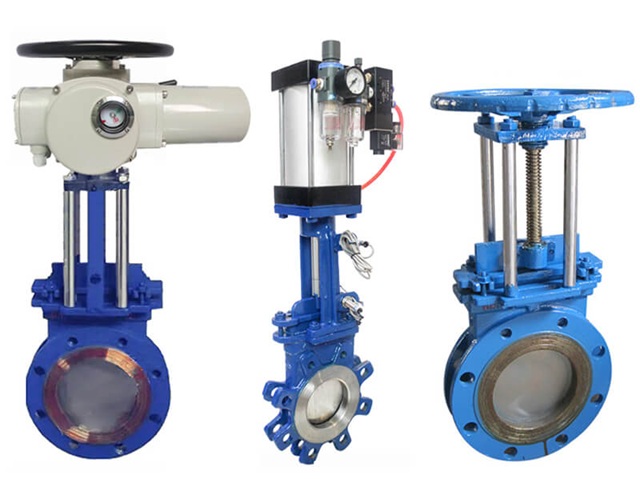
Applications of the Electric Knife Gate Valve
At the heart of complex industrial processes, the need arises for control solutions that surpass the capabilities of conventional valves. The electric knife gate valve is one of the most efficient innovations for handling fluids with a high solids or fiber content. Combining the mechanical strength of the “knife” with the digital precision of the electric motor. This valve has become essential in the mining, water treatment, and paper industries.
First: Engineering Analysis and Operating Principle
The electric knife gate valve relies on a simple yet powerful linear motion mechanism. The valve consists of a thin metal gate with a beveled, knife-like lower edge.
- Cutting Mechanism: When the electric motor receives the closing signal, it converts electrical energy into rotational motion, which is then transferred via the valve stem into linear motion that pushes the gate downwards. The sharp edge of the gate is designed to cut through fibers, sediment, or viscous materials that may accumulate in the valve body.
- Sealing: When the gate reaches the bottom, it is pressed against the valve seat, which is often made of flexible materials like EPDM or rigid materials like Stellite, ensuring 100% leak-proof operation.
- Smart Operation: The electric actuator not only opens and closes the valve but also provides real-time data on the valve’s status (open/partially closed) and allows for precise flow rate control via PLC systems.
Read also: What are Knife Gate Valves and What are they Used For?
Second: Advanced Technical Features
The advantages of this valve go beyond simply “cutting” the valve, offering strategic benefits for factories:
- Overcoming Corrosion and Blockage: In conventional valves, solids accumulate in the gaps and prevent sealing. In the knife valve, the “self-cleaning” design expels materials away from the sealing area.
- Full Automation (Automation Ready): The electric actuators eliminate the need for manual intervention, reducing human error and enabling the valve’s integration into the Industrial Internet of Things (IIoT).
- Space-saving design: This valve features a slim (short face-to-face) design, making it ideal for installation in tight spaces and close-set pipes.
- Variable pressure resistance: Despite its slim profile, its modern engineering allows it to withstand high operating pressures and high flow velocities.
Third: A Wide Range of Industrial Applications
Wastewater Treatment
Wastewater is a hostile environment for conventional valves due to the presence of hair, fibers, and grit. The electric knife valve acts as a gatekeeper, easily cutting through fibers and preventing blockages in main lines, especially in primary treatment plants.
Pulp and Paper Industry
This industry is the native home of the knife gate valve. Here, fluids are saturated with sticky wood fibers. The electric motor ensures a constant gate force to penetrate the dense pulp and stop the flow when maintenance is required.
Mining and Slurry Processing
In gold or copper mines, the minerals are transported in the form of a highly abrasive slurry. The knife gate valves here are manufactured from highly corrosion-resistant materials to ensure a long service life despite the harsh nature of the materials being transported.
Chemical and Petrochemical Industries
These valves are used to control the flow of dry chemicals or liquids that tend to crystallize. The electric motor, equipped with high torque, ensures the breaking of any crystals that accumulate on the seat.
Power Plants
In thermal power plants, they are used to control the flow of fly ash produced from coal combustion. The temperatures are high, and the material is very soft and prone to clogging.
Fourth: Criteria for Selecting the Right Electric Valve (Buyer’s Guide)
Choosing the wrong valve can lead to production downtime. Here’s what to consider:
Media Analysis:
- If the material is acidic, 316 stainless steel should be chosen.
- If the material is abrasive, hardened metal seats should be used.
Actuator Specs:
- Voltage: (220V, 380V, or 24V DC).
- Closing Time: Some processes require rapid closure, while others require slow closure to avoid water hammer.
Environmental Conditions:
If the valve is to be installed outdoors, the actuator must have an IP67 rating or higher for rain and dust resistance.
Seating Type:
- Soft Seat: For water and clean fluids (complete seal).
- Metal Seat: For solid materials and high temperatures (more durable but may allow microscopic leakage).
Read also: Factors that make you decide to choose a knife gate valve
Fifth: Preventive Maintenance and Extending Valve Life
To ensure the electric valve operates for decades, a strict maintenance schedule must be followed:
- Regular Lubrication: The valve stem must be lubricated regularly to ensure smooth operation and reduce load on the actuator.
- Wiring and Cable Inspection: Ensure there is no corrosion in the electrical connections to prevent short circuits or signal failure.
- Valve cavity cleaning: Although self-cleaning, periodic inspection helps remove any very hard deposits that could scratch the gate surface.
- Motor calibration: Ensure that the limit switches are precisely adjusted so that the motor stops as soon as the gate reaches the end of its path.
Sixth: Future trends and “fourth-generation” valves
With the advent of the Fourth Industrial Revolution, electric knife gate valves are beginning to evolve into “smart devices.” Actuators are now available with:
- Self-diagnosis: The valve sends an alert to the engineer’s phone before it fails, based on changes in electrical current consumption.
- Wireless communication: Controlling valves in remote areas via 5G or satellite technologies.
Seventh: Technical comparison (Design) Knife Gate vs. Conventional Valves
To understand the true value of an electric knife gate valve, it must be compared to a conventional wedge gate valve. In conventional valves, there is a “gap” or groove at the bottom of the valve body. Where the gate rests when closed. The applications containing deposits or fibers, this gap fills with solids, preventing the gate from fully descending and leading to permanent leakage and insulation failure.
In a knife gate valve, however, the design is completely without this gap. The gate slides between side seals, and when closed, the sharp edge cuts through any obstructions. This fundamental difference is what makes the electric knife gate valve superior in uptime and reduces unplanned maintenance downtime by up to 60% in harsh operating environments.
Eighth: Fail-Safe Systems Analysis
A crucial addition in modern systems is the safety technology integrated with the electric motor. Because the valve is powered, a power outage can pose a risk in some critical processes. Therefore, these valves are equipped with:
- Backup power units (supercapacitors or batteries): These allow the valve to automatically open or close in the event of a power outage (fail-safe position).
- Manual override: The electric motor always includes a handwheel that allows technicians to manually move the valve in case of a circuit failure, ensuring the system remains under control.
- Torque protection: If a very solid obstruction prevents the gate from moving. An electrical sensor immediately cuts power to the motor to prevent the windings from burning out or the valve stem from breaking.
Ninth: Operational Challenges and How They Were Overcome
Despite its efficiency, engineers faced a long-standing challenge called “stuffing box leakage.” With the repeated movement of the gate, small particles may escape into the stuffing area. The modern solution: Advanced self-adjusting packing systems were developed that use internal compression springs to maintain a tight seal around the gate, even as the rings wear down over time. The use of Teflon or ceramic coatings on the gate also reduces friction, extending the life of the electric motor and decreasing energy consumption by 15%.
Tenth: Economic Feasibility and Return on Investment (ROI)
When considering cost, an electric knife gate valve may be more expensive than manual or simple butterfly valves. However, its Total Cost of Ownership (TCO) is the lowest.
- Reduced Labor: Automation means no dedicated maintenance team is needed to manually open and close large valves.
- Protection of Pumps: The tight seal prevents abrasive materials from entering pumps at the end of the line, protecting equipment worth hundreds of thousands of dollars.
- Protection of Process: In desalination and chemical plants, precise control of partial valve opening reduces waste of chemical raw materials.
Conclusion
An electric knife gate valve is not just a fluid-cutting device. It is an investment in the stability of the production process. Its unique ability to handle the harshest environments, combined with precise electrical control, makes it the top choice for engineers seeking efficiency and reliability. With the continuous advancements in materials science and artificial intelligence. This valve will remain an indispensable component in the factory of the future.